2028 Dodge Charger Daytona Redesign, Specs, Configurations
2028 Dodge Charger Daytona Redesign, Specs, Configurations – The 2028 Dodge Charger Daytona could become one of the most intriguing performance cars of the decade as Dodge continues balancing electric propulsion with the brand’s traditional obsession with horsepower, acceleration and aggressive styling. The modern Charger has already taken an unusual path by offering both an all-electric Daytona and gasoline-powered SIXPACK versions under the same nameplate. For 2027, the Daytona remains the electric performance flagship, with the Daytona Scat Pack producing 670 horsepower, 627 lb-ft of torque and an estimated 3.3-second 0-to-60-mph time. The 2028 model is not yet officially detailed by Dodge, so any discussion of its future specifications must separate confirmed technology from reasonable projections.
The current Charger Daytona is already very different from the V8-powered muscle cars that built the Charger reputation. Instead of a conventional engine and transmission, the Daytona uses a 400-volt electrical architecture, front and rear electric drive motors and a high-voltage lithium-ion battery. Dodge designed the system around repeated high-power operation, with the battery capable of an initial 550-kW discharge before settling into a sustained rate above 500 kW. That hardware helps explain why the electric Charger can deliver extraordinary acceleration while retaining all-wheel drive. A future 2028 version could refine this formula with better thermal management, software calibration, charging performance and battery efficiency rather than completely reinventing the platform.
Dodge’s broader strategy also makes the 2028 Charger Daytona particularly interesting. The company is no longer presenting the Charger as an exclusively electric vehicle. Gas-powered R/T and Scat Pack models use the 3.0-liter twin-turbo SIXPACK inline-six, with outputs of 420 and 550 horsepower respectively, while the 2027 Super Bee Launch Edition pushes the gasoline version to a targeted 600 horsepower. That means the Daytona has to maintain a distinctive reason for existing. Its advantage is not simply horsepower; it is instant electric response, all-wheel-drive traction, near-silent propulsion when desired and the ability to deliver repeated high-output acceleration without the mechanical characteristics of an internal-combustion engine.
For 2028, we should therefore expect the Daytona to remain a technology-driven interpretation of Dodge muscle rather than a conventional replacement for the SIXPACK cars. A major visual redesign is unlikely so soon after the current generation’s launch, but targeted improvements could make the electric Charger more attractive to buyers who want long-distance usability as well as extreme acceleration. Better charging, more range, improved infotainment, enhanced driver assistance and new performance software would all make sense. Dodge has not confirmed a 2028 Charger Daytona, specific pricing or a release schedule, so those details remain projections rather than official specifications. 2028 Dodge Charger Daytona Redesign
2028 Dodge Charger Daytona Redesign and Update Plan
Exterior & Interior
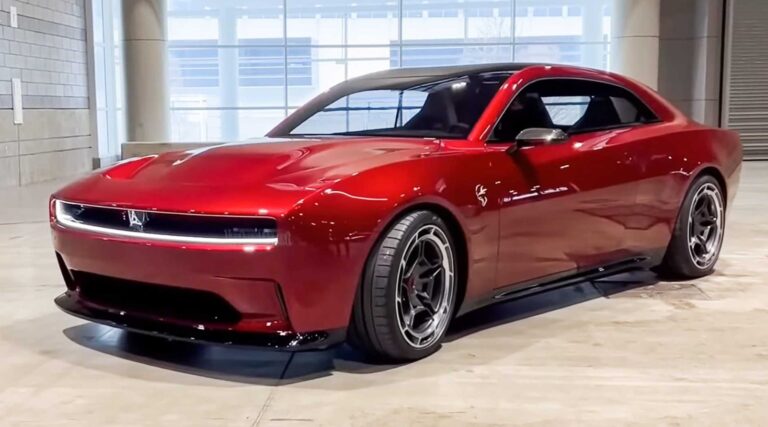
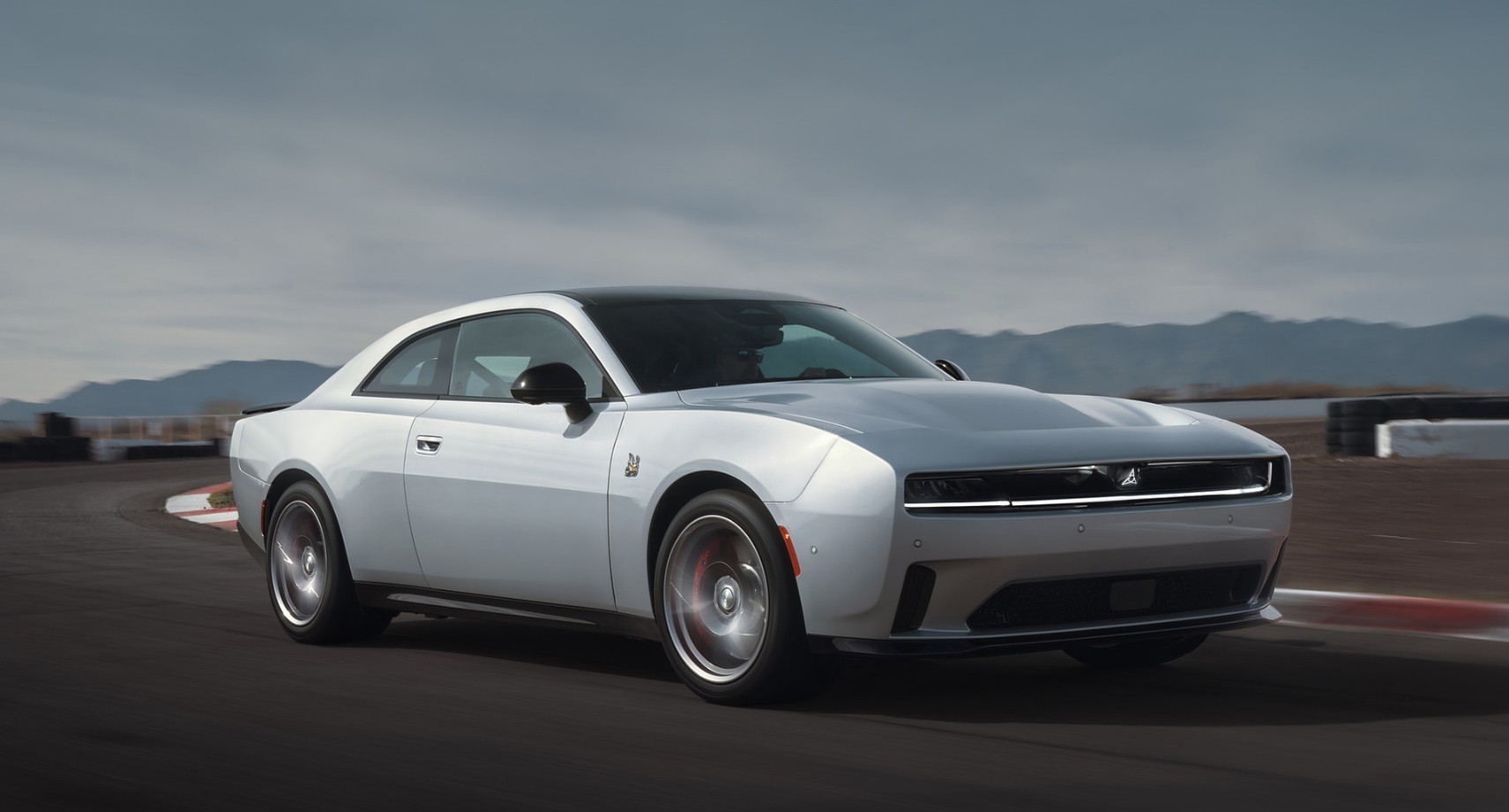
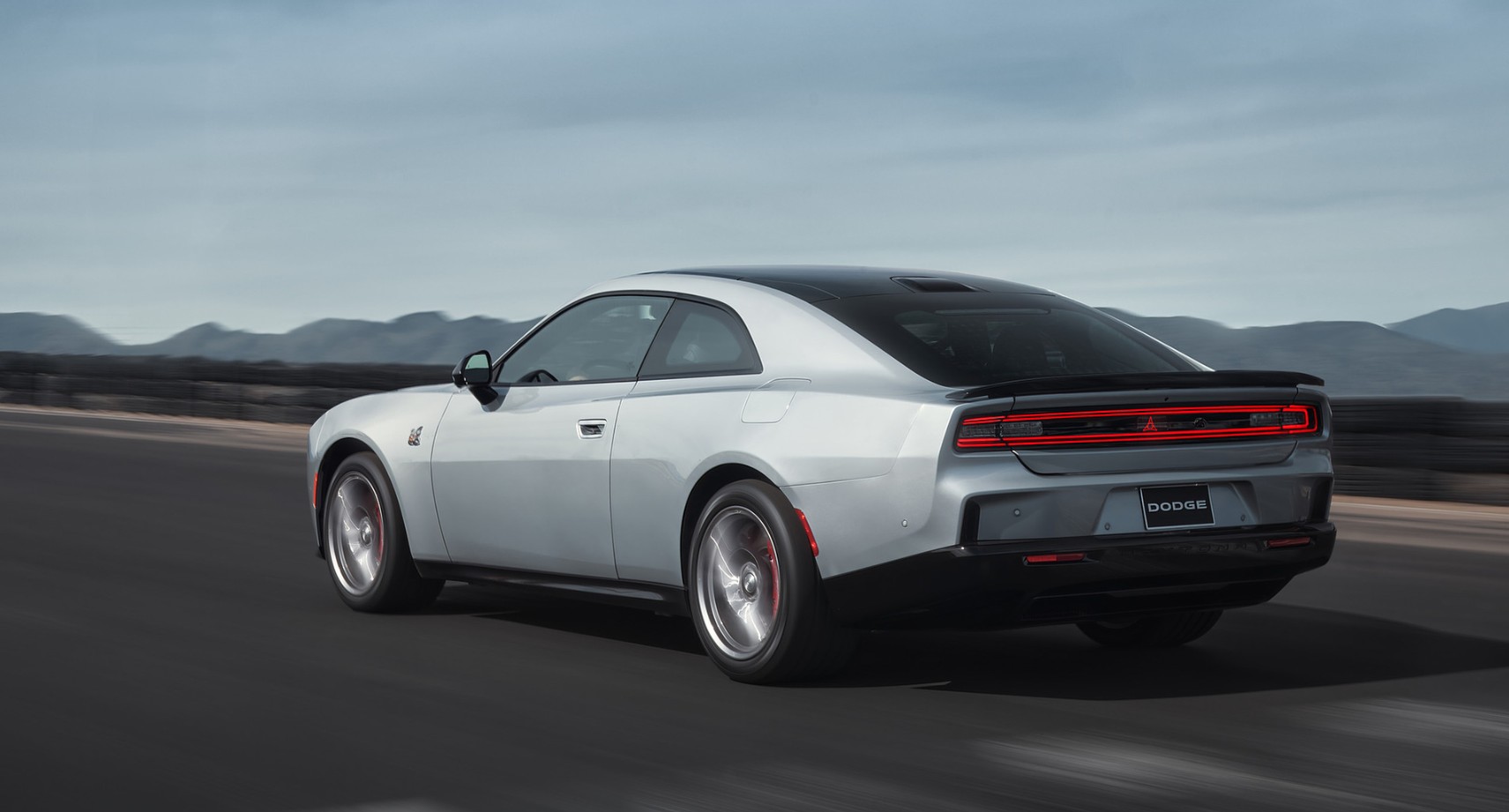
The exterior of the 2028 Dodge Charger Daytona should continue the current generation’s attempt to connect modern electric performance with classic Dodge heritage. The long, low profile, broad shoulders and muscular wheel arches give the Charger a presence that immediately separates it from conventional electric sedans. Unlike many EVs that emphasize aerodynamic smoothness above all else, the Daytona deliberately retains visual drama. The front end incorporates the signature R-Wing treatment, while the rear profile and widebody proportions create the impression of a traditional American performance coupe. If Dodge continues the design, new colors and graphics may be more significant than major body changes.
Dodge has already shown that personalization remains a major part of its performance strategy. For 2027, the Charger lineup received additional colors including Red Oxide, while Dodge continues to offer appearance packages and performance-focused options. A 2028 Daytona could expand that approach with limited-production heritage colors, contrasting stripes, new wheel finishes and perhaps special Daytona graphics. A high-performance edition could receive carbon-fiber aerodynamic elements, a darker grille treatment and unique badging. Such changes would give the electric model its own identity without separating it completely from the broader Charger family.
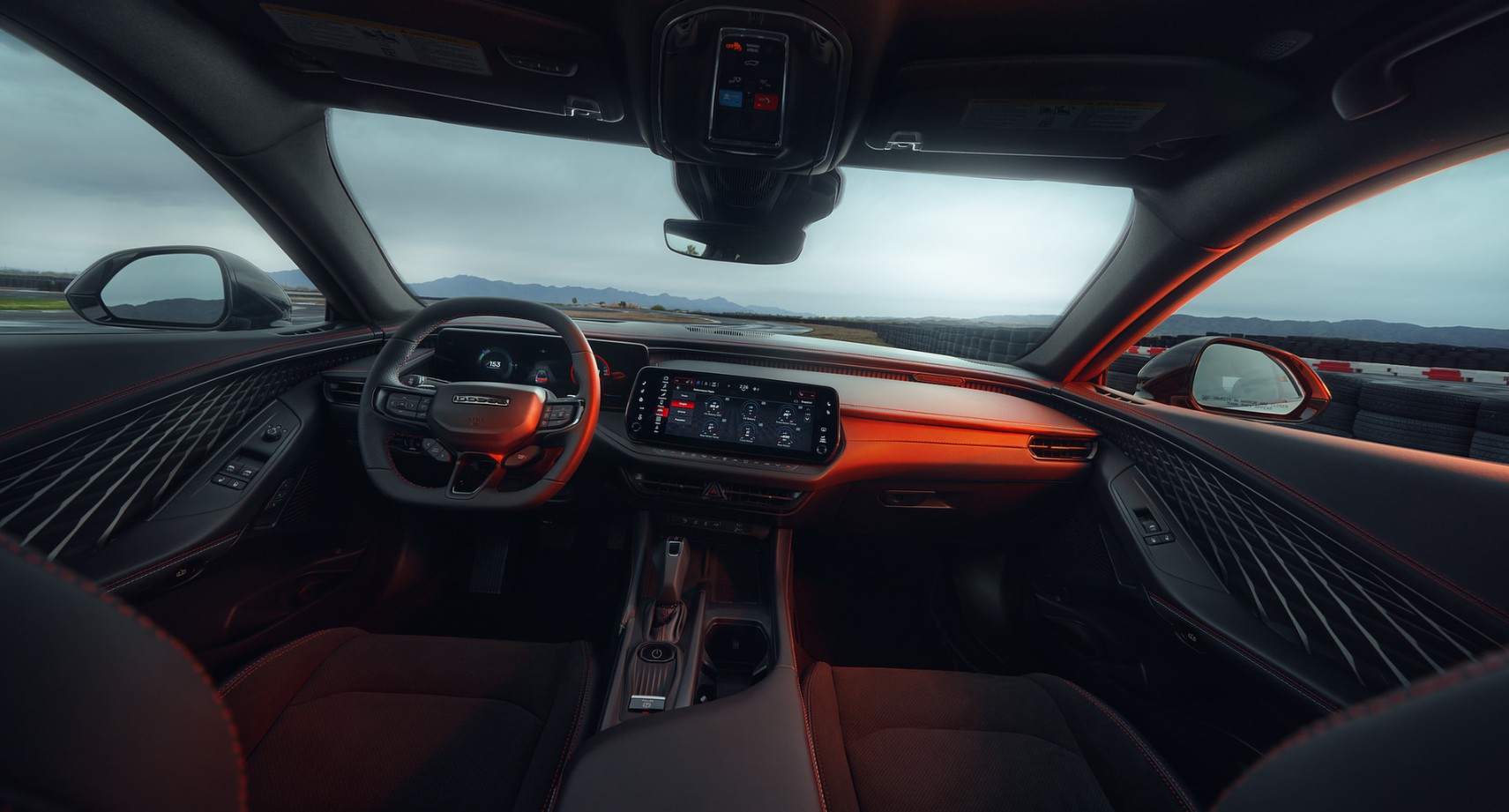
The interior could receive more substantial improvements. The current Charger uses a driver-focused cockpit with free-standing digital displays, performance controls and available 64-color Attitude Adjustment Lighting. Dodge also offers a heated flat-top and flat-bottom steering wheel with dedicated controls. For 2028, the emphasis could shift toward software and personalization. A larger or faster infotainment system, improved voice controls, additional performance data and customizable digital gauges would suit the Daytona’s character. Drivers could potentially select different display layouts for street driving, drag-strip launches and circuit work, turning the dashboard into an information center rather than simply a navigation screen.
Passenger and cargo practicality should remain another Charger advantage. The current generation was developed as a large, usable performance car rather than a tiny sports coupe, and Dodge offers both two-door and four-door body configurations. The hatchback-style rear opening gives the Charger a level of cargo flexibility that traditional three-box performance sedans often lack. A 2028 Daytona could improve cabin materials, front-seat bolstering, rear-seat comfort and storage while retaining the broad practical layout. A premium Daytona package could add ventilated performance seats, upgraded audio, suede-like materials and more extensive ambient lighting.
The most logical redesign strategy for 2028 would be evolutionary. The current Charger already introduced a dramatically different interpretation of the classic muscle-car silhouette, combining a wide stance with a modern fastback profile and distinctive front lighting. Dodge describes the next-generation Charger as a widebody performance vehicle, and the Daytona’s bodywork is shaped around both aerodynamics and visual aggression. Rather than replacing that design after only a few model years, Dodge could make smaller changes to the front fascia, lighting graphics, wheels and aerodynamic components. A revised illuminated Fratzog emblem, sharper daytime-running lights and new performance-oriented colors could provide the visual freshness expected from a new model year without requiring a costly body redesign.
Aerodynamic development could become more important as Dodge continues improving the electric Charger. The current Daytona uses a distinctive R-Wing aerodynamic concept that allows airflow through the front of the vehicle while preserving the visual identity of the Charger. A future 2028 model could refine this system with more sophisticated active aerodynamic control. Adjustable front airflow, a revised rear spoiler and electronically managed cooling shutters could help the car balance highway efficiency with track performance. At high speed, the system could prioritize stability and cooling, while normal highway driving could favor reduced drag. Such improvements would be particularly valuable because every reduction in aerodynamic resistance can contribute to additional real-world electric range.
The wheels and tires would also be a likely area for refinement. The current Daytona supports a staggered setup with wide 305/35ZR20 front and 325/35ZR20 rear Goodyear performance tires, emphasizing lateral grip and stability. Dodge has also developed high-performance braking hardware and adaptive damping for the Charger platform. A 2028 Daytona could introduce lighter forged wheels, a new high-performance tire compound or improved brake cooling. Weight reduction would be especially valuable because the current battery pack weighs roughly 1,350 pounds. Reducing unsprung mass could improve steering response and ride quality without sacrificing battery capacity.
The most meaningful update could occur beneath the body. Battery software, inverter efficiency and electric-motor calibration can evolve rapidly without requiring a completely new platform. Dodge could improve usable battery capacity, thermal management and regenerative braking while maintaining the same basic 400-volt architecture. The 2027 Daytona already features adjustable regenerative braking and brake-by-wire technology, giving engineers considerable control over how the car behaves during acceleration and deceleration. A 2028 update could make those systems more seamless in daily driving while offering more aggressive calibration for track use. 2028 Dodge Charger Daytona Redesign
2028 Dodge Charger Daytona Specs
Engine & Performance
The defining feature of the 2028 Dodge Charger Daytona will remain its electric powertrain. The current Daytona Scat Pack uses two electric drive motors, one at each axle, providing standard all-wheel drive and a combined 670 horsepower with 627 lb-ft of torque. Dodge targets 3.3 seconds for 0-to-60 mph and an 11.5-second quarter mile. Those numbers already put the Daytona in serious supercar territory for straight-line acceleration. A 2028 update does not necessarily need dramatically more power; better consistency, thermal control and traction management could make a more meaningful difference during repeated performance runs.
Still, a modest increase in output is possible. Dodge has demonstrated that the Charger platform can accommodate substantial performance development, with the gasoline Super Bee reaching a targeted 600 horsepower for 2027. An electric Daytona with 700 horsepower or slightly more would be technically plausible, particularly if battery and inverter improvements provide additional sustained discharge capability. However, Dodge has not announced such an output. Any projection above the current 670 horsepower should therefore be regarded as a possibility rather than an expected factory specification.
The driving character should be more important than a simple horsepower figure. The Daytona’s front and rear motors allow software to vary torque distribution rapidly, while the front motor includes a wheel-end disconnect designed to improve efficiency and range when its additional traction is unnecessary. The rear motor incorporates a mechanical limited-slip differential. This arrangement gives Dodge the ability to create several distinct personalities: stable all-wheel-drive launches, rear-biased behavior for performance driving and efficiency-focused operation when full front-axle assistance is unnecessary.
2028 Dodge Charger Daytona Fuel Economy
Fuel economy and range will remain the biggest challenges for a high-performance electric Charger. Dodge currently quotes more than 260 miles of all-electric range for the 2027 Daytona Scat Pack, while earlier official specifications listed approximately 241 miles for Scat Pack models depending on configuration and testing cycle. The 2028 model could potentially move closer to 280 or even 300 miles through battery-management improvements, lower rolling resistance and more efficient motors. However, aggressive driving, cold weather, high-speed highway travel and repeated launches can reduce real-world range substantially. A performance EV cannot simultaneously maximize range and deliver unrestricted track performance without compromises.
2028 Dodge Charger Daytona Safety Features
The 2028 Charger Daytona should continue Dodge’s transition toward more advanced electronic driver assistance without compromising the performance-oriented character of the car. A modern performance vehicle needs sophisticated stability control, traction management, electronic braking and tire monitoring, particularly when it can produce hundreds of horsepower instantly. The current Charger platform already integrates brake-by-wire technology, adjustable regenerative braking and advanced performance systems. The available high-performance braking package uses six-piston front and four-piston rear Brembo calipers with large ventilated rotors, while the adaptive damping system can alter compression and rebound behavior.
For daily driving, the 2028 Daytona could add more sophisticated active-safety functions, potentially including improved adaptive cruise control, lane-centering assistance, blind-spot monitoring, rear cross-traffic detection, automatic emergency braking and enhanced pedestrian detection. Dodge has not published a 2028-specific safety package, so these features should be considered likely development areas rather than confirmed equipment. The car’s software architecture also creates opportunities for over-the-air updates, allowing certain driver-assistance and vehicle-control functions to improve after the vehicle leaves the factory. That could become increasingly important as Stellantis develops more centralized electronic systems.
2028 Dodge Charger Daytona Release Date & Price
The release date remains unconfirmed. Dodge has published detailed 2027 Charger information and continues to sell the Daytona as part of the multi-energy Charger lineup, but there is no official announcement establishing a specific 2028 Daytona launch date. The current 2027 Charger lineup includes both electric Daytona and gasoline SIXPACK models, and Dodge has also introduced the 600-horsepower Super Bee Launch Edition for the 2027 model year. If Dodge maintains the current product cadence, a 2028 model could arrive in late 2027 or during calendar-year 2028, but that timing should not be treated as confirmed. The more important question is whether the Daytona continues alongside increasingly powerful gasoline Chargers.
Trim strategy is another area where Dodge could make the Daytona lineup more interesting. The current electric range is centered around the Daytona Scat Pack, with Plus equipment available, while the Daytona R/T has appeared in Dodge’s model information with lower power and longer range. Dodge’s current FAQ identifies the Daytona R/T at 496 horsepower and the Daytona Scat Pack at 670 horsepower, with quoted ranges of 308 and 241 miles respectively in the relevant configurations. For 2028, Dodge could simplify the electric lineup around a range-focused R/T, a high-performance Scat Pack and a potential limited-edition flagship.
Pricing is harder to predict because Dodge has already changed the electric Charger’s pricing substantially between model years. Current 2026 Dodge pricing lists the two-door Daytona Scat Pack from $59,995 and the four-door version from $61,995, while Plus versions cost more. For 2027, reporting from Car and Driver indicates that the Daytona Scat Pack’s starting price increased substantially to $74,490 for the two-door model. If a 2028 Daytona remains in production, a reasonable projection would put a lower-output electric model somewhere around $60,000–$70,000, while a Scat Pack could sit around $75,000–$85,000 before destination and options. 2028 Dodge Charger Daytona Redesign
Conclusion
The 2028 Dodge Charger Daytona sits at an unusual point in the history of American muscle. The current Daytona has already demonstrated that Dodge can translate its traditional performance philosophy into an electric platform without abandoning dramatic styling, extreme acceleration or an aggressive driving experience. With 670 horsepower, 627 lb-ft of torque, a targeted 3.3-second 0-to-60-mph time and more than 260 miles of current Scat Pack range, the electric Charger is already a serious performance machine.
The bigger challenge for 2028 will not simply be adding horsepower. Dodge now has gasoline Chargers producing 420, 550 and a targeted 600 horsepower, giving buyers several ways to experience the modern Charger. The Daytona therefore needs to establish its own strengths through instantaneous response, intelligent torque distribution, fast charging, improved range and sophisticated performance software.
A future update could make the Daytona more compelling through incremental engineering rather than a dramatic redesign. Better battery efficiency, improved thermal management, lighter wheels, revised suspension calibration, more advanced software and stronger charging performance could all improve the ownership experience. Range approaching 300 miles would also make the Daytona easier to justify as a daily vehicle while maintaining its performance credentials.
For now, Dodge has not confirmed the exact 2028 Charger Daytona specification, price or release date. What is certain is that the current platform provides a strong technical foundation. The electric Charger has already pushed beyond 600 horsepower, uses a sophisticated dual-motor AWD system and offers performance technology that would have seemed extraordinary for a mainstream American muscle car only a few years ago. If Dodge continues developing that formula, the 2028 Charger Daytona could become less about proving that an EV can be a muscle car and more about defining what the next generation of American performance should feel like.